Here’s the short version: Every community-based site in the history of the web has essentially been a stab at creating a social network. Most of them fail as businesses, with the rare exception of small, lucky communities that become self-sufficient but not exactly prosperous. What if that’s just the way it is?
Here’s the longer version. Let’s start with some seemingly unrelated bullet points. I was dreaming when I wrote this, so forgive me if it goes astray.
Before the web, I worked for alternative weekly newspapers. There was conventional wisdom even then that the business of running a weekly paper sucked. But we weren’t in it for the money, we were in it because it was important to the community the weekly served. We made enough from advertising to print the paper and deliver it to the readers. It was very rarely profitable. In the alt newsweekly world of the early 90s, breaking even was considered the success case. We did it anyway.
This week it was announced that Digg, once valued in billions, had been sold for 500k. An inglorious end to a once beloved social media darling. Digg was attempting to scratch a particular community itch. It tried to make sharing newsy links social, and you could follow friends, which is the basic element of any social network. It worked, for a time, but it was never profitable.
Last month Facebook, certainly the biggest player in the “let’s monetize a social network” game went public and their stock price took an immediate flop and has been bouncing around like a fish out of water ever since. The question on everyone’s mind: How will they make money from all those free members? Without souring the milk, of course.
Twitter and Tumblr, both incredibly successful at cultivating their communities, both yet to prove how exactly they’re going to survive as businesses.
Last week it was announced that the WELL, an online community that predates the web, was to be sold by its present owner, Salon (a business relationship thats’s always been a head-scratcher to me). The community is currently rallying to buy itself.
When I wrote a book about community sites 11 years ago, I included many examples of sites doing it right. Almost all of them have died since. One that hasn’t: MetaFilter, a small community company supporting a small staff that makes money through advertising and membership costs.
Can you see a pattern here?
The flow, as I see it, works like this.
We want to be a social network. The more people in it, the more “value” it has, so we need everyone to join. Because we want everyone to join, we cannot put up a pay barrier, so we have to make money another way. Let’s say advertising. (Note: Most never make it this far.)
Our advertisers want as much data about, and contact with, our users as possible. We want to only allow limited engagement. Either advertiser interest wanes (Flickr), or we coast on our investment (Twitter, Tumblr), or we give in and let the advertisers run the show (pretty much everyone else).
Members become angry at us because we’re selling them out. The exodus begins. There’s always somewhere else to go (see Friendster, MySpace). Go back to step 1.
See it? The bigger you go, the harder the road. Meanwhile, small, focused, and yes, exclusionary community sites flourish. Matt Haughey made several key decisions in the formation of MetaFilter, but the most important one was to limit growth. Hell, for years you couldn’t get an account if you wanted one. After that, they started costing money. When it costs money at the door, that means you don’t have to sell out your members to advertisers. It also means the community stays small, which – surprise! – also leads to healthier communities.
What if we all realized that social networks are a societal good (at least as good as a local alt weekly) but not necessarily good businesses? We’re all desperately hoping that Twitter or Facebook or Tumblr will figure out the secret ingredient that turns a large-scale community of free members into a cash machine. What if we’re all just waiting for the impossible? Like a business that turns water into gold? We’ve got lots of water, we just need to figure out the gold part….
What if we eventually realize that, like the alt weeklies, these are things we do because they should be done, because it’s fun, to make our little community a better place … not because they’re going to be great businesses.
Because so far, when you look at the numbers, that’s just what they are: not great businesses.
The one truly great business born of the web is Google, and not their self-driving cars and the other nonsense that accounts for zero percent of their income. It’s putting small, self-serve ads beside their search results. You and I create those search results with our behavior online, but not directly on Google. And that line between where I’m using my voice (you’re soaking in it) and where it’s being monetized (*cough*) is enough of a separation that it doesn’t bother me. The problem happens when the content creation happens in the same place as the ad deployment. So, of course, that’s exactly what Google’s trying with Google+, to less than stellar results.
My point with this thought experiment is this: What if we designed a social network to be small, self-supporting, and independent from the outset? How would it look, work, and feel? I bet it would come out looking nothing like the ones we’ve got now, the ones still trying to turn water into gold.
+
UPDATES:
Looks like Digg sold for more than reported. Seems like a complicated deal.
I forgot to mention the original social network: the phone book. Not a sexy business.
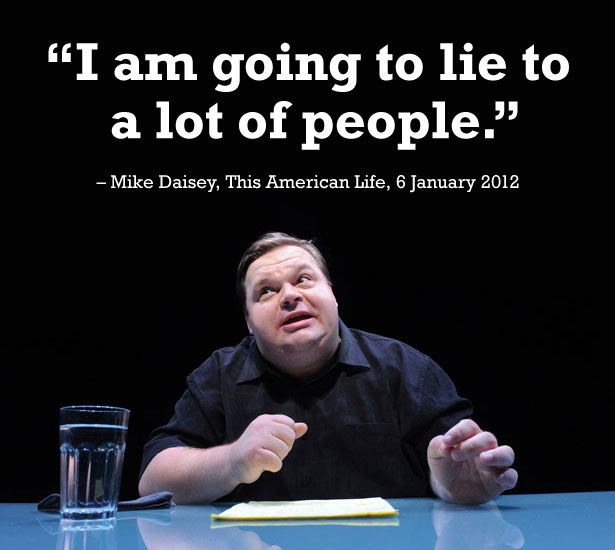
Like most people, I’ve been lied to a few times in my life. I’ve even told a few (though, as my wife will attest, perhaps not as many as I should). No one likes being lied to.
That’s one of the reasons I was attracted to journalism and photography – they’re about telling the truth. It may be a personal, subjective truth, but it’s a truth nonetheless.
It’s also why I started a magazine all about true stories. We even held a series of storytelling performances not unlike Mike Daisey’s theater show.
But I’m not going to get into the subjective nature of truth, what’s appropriate in theater, or Mr. Daisey’s seemingly pathological need to nail himself to a cross. I just wanted to share this one observation.
Like anyone who’s been lied to, I’ve made an effort to become more aware of when the person talking to me may be a liar. This can get complicated. You can get caught up in lots of micro-expressions, language patterns, and telling gestures. But in my experience, there’s one sure-fire way to know when you’re dealing with a liar: they tell you.
In context, he’s saying this to his interpreter, in an effort to convince her to help him pose as a businessman (an effort that, we now know, was also largely fabricated because his translator needed no convincing and planned to do this from the outset).
When I heard him say that in the original story, I was driving down Divisadero in my car, and I blurted out: “Then how can I trust anything you say?”
Here was a man telling an extraordinary story and admitting that he was a liar. If he lied to those businessmen, how could we really know he wasn’t lying to us?
There’s a reason that journalists are trained not to do this, and it’s not just highfalutin professional ethics. It’s far more practical: If you lie to get the story, it throws the entire story into doubt. Tell the audience you’re a liar and they stop believing you. Or, at least, they should.
If you traffic in true stories, you can’t lie to your audience, period. I don’t care if it’s in a book or on a stage or over the radio. When you tell a personal story, you absolutely know if the words coming out of your mouth are true or not.
Mike Daisey knew he was lying to us. I’ll never believe another word he says.
There’s an old Firesign Theater sketch called “Temporarily Humboldt County.” Some Native Americans are sitting around enjoying nature when the Spanish conquistadors show up with a priest. The conquistadors claim the land for Spain and Father Corona adds, “Oh! By the way, Domini Domini Domini, you’re all Catholics now.”
I was reminded of this sketch on Tuesday when Flickr decided I was a Christian.
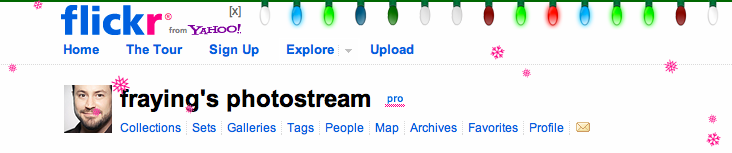
Since Tuesday, if you visit any Flickr member’s photos with a modern browser, you’ll see three little snowflakes beside the Flickr logo. Click them and you’ll be treated to a cascade of snowflakes over the page and all its photos, as well as a row of blinking Christmas lights at the top of the page. For an added treat, you can roll over the lights with your mouse and they’ll pop, complete with sound effects. Click the little “[x]” beside the logo and it all goes away … at least until the next page load when the three little snowflakes show up again.
Flickr is the community website that’s closest to my heart. The site’s founders are friends of mine and my wife worked there for five years. But more important than that, it’s a community that I love. I’ve uploaded gigabytes of photos there. My photostream has become a virtual home for me. Our virtual homes are just as important to us as our brick and mortar ones, if not more. I’ve lived in my real house for a few years, but I’ve lived on Flickr since 2004.
So it’s distressing when someone puts Christmas lights on my virtual home. I’m not a Christian. I don’t care how secular the holiday is nowadays. I know about the holiday’s Pagan roots. None of that matters. The fact is, Christmas lights on a home are a signifier that the occupant is a Christian, the same way a mezuzah is a signifier of a Jewish occupant. These symbols have power, which is why we use them.
It’s not just that Flickr is smearing Christmas “cheer” all over itself. As a non-Christian in a Christian country, I’m grudgingly used to that. (Though it would be nice if clicking that “[x]” set a cookie that prevented it from loading on the next pageview.) It’s that my Flickr stream is my personal identity in the Flickr community. That’s my face there at the top. Flickr has added a Christian signifier to my virtual home and I have no way to remove it. In the eyes of the rest of the community, Flickr has turned me into a Christian.
Flickr has done other Christmassy things in the past. For a while, you could add a string to a URL to make it snow on the page. Other years, if you put a note on a photo with a special phrase (“ho ho ho hat”), a Santa hat would appear. But these were all secret easter eggs. (Easter! We can’t even talk about this without more Christian holidays coming up.) And in the case of the notes, I could easily remove them and control who has the power to leave notes on my photos. But this year’s festivities are unavoidable. Don’t like people seeing Christmas lights on your virtual home? Too bad.
When you begin a virtual community, you’re building for yourself. You can safely assume that most of the community is a lot like you. But as it grows, the community becomes more diverse. If you’re extremely lucky, some of your members will invest themselves so much, they’ll come to view the site as a kind of home. This, by the way, is the success case. It’s what you want to happen.
Flickr is now a truly global community. A huge set of their members don’t celebrate Christmas. Heck, it’s summer in half the world right now, so I’m not sure what they’ll make of the snowflakes. Flickr should know this better than anyone.
The decision to put Christmas lights on all of their members’ virtual homes shows a profound lack of understanding for who their users are and what those symbols mean. It’s the kind of decision you make when you assume the rest of the world is just like you, or you’re so enamored with a technology you forget to think through the social ramifications of its implementation. Making your members feel unwelcome in their own homes is the first step in the decline of a community.
The lights and snowflakes will go away after Christmas, but I’ll still be incredibly disappointed in one of my all-time favorite sites.
What Flickr Should Have Done
It’s undeniable that the snowflakes and Christmas lights thing is a cute technology demo. So what should they have done with it? Here are my top five suggestions.
Don’t. Not all your members celebrate Christmas.
If you must, limit it to pages with multiple voices, like the Flickr blog, search results, tags, and the homepage. That way you’re not accidentally converting individual members.
Really, don’t. People see their pages as their homes. Would you put Christmas lights on someone else’s house?
If you must, make it an easter egg. Trigger it with a search, like Google’s “do a barrel roll” or other hidden behavior. Let people discover it and pass it along on Twitter and Facebook. It’ll be seen as cool and special by those that find it, and it won’t annoy the others.
And for Christ’s sake, give those of us that don’t celebrate Christmas a way to turn it off and never see it again.
In 1986, when R.E.M. released Life’s Rich Pageant, I was 13 and not nearly cool enough to know about R.E.M. But by the time I was 18, I’d met a girl with far better taste, who turned me on to a number of things, including R.E.M. She gave me a tape with Life’s Rich Pageant on Side A and Murmur on Side B. (Kids, ask your parents if you don’t know what a cassette tape is.) It’d be going too far to say it changed my life, but fair to say it give me a soundtrack to some of the best, and worst, moments of my life for the next two decades.
Life’s Rich Pageant contains a humble song, “Swan Swan H,” that stands out not just from the rest of the album, but from the whole of R.E.M.’s catalog (though it’d fit in quite nicely with today’s Decemberists). It begins with a simple old folky 12-string guitar, and Michael Stipe’s haunted words.
Swan, swan, hummingbird
Hurrah, we’re all free now
What noisy cats are we
Girl and dog he bore his cross
The lyrics go from there on a long chain of poetry that, to this day, I can only understand on an emotional level. Some sources say that the song is “about the Civil War” but that’s as much insight as I’ve ever found.
I listened to the song so often, it just became part of my subconscious. I learned how to play it and would often serenade myself with it on lonely nights in between cigarettes. I owned a 12-string acoustic for a time in college, so I could play it right. I had to sell that guitar later when money was tight. I still miss it.
Skip ahead to now and the song is still with me. It plays when my wife calls, the only custom ringtone on my iPhone, because it was the song that reminded me most of Heather. (Or did I marry Heather because she reminded me of the song? Either way, they’re both gentle, beautiful, and deep.)
I don’t believe that songs have to be perfectly understood to be enjoyed. The lyrics wander, with layers of references no one could fully understand unless they’re Michael Stipe. But of all the song’s mysteries, the one I’ve thought about most is the first three words. What the hell does “Swan Swan Hummingbird” mean? Now, after 20 years of it rattling around in my head, I think I finally know.
Swan, swan, hummingbird
Hurrah, we are all free now
A long, low time ago, people talk to me
I’ve been trying to wake up earlier lately, using my iPhone as an alarm clock. I was getting tired of being woken up by the buzzing, so I shut vibration off and then realized I could set a ringtone to play instead. Of course, I picked “Swan Swan H.”
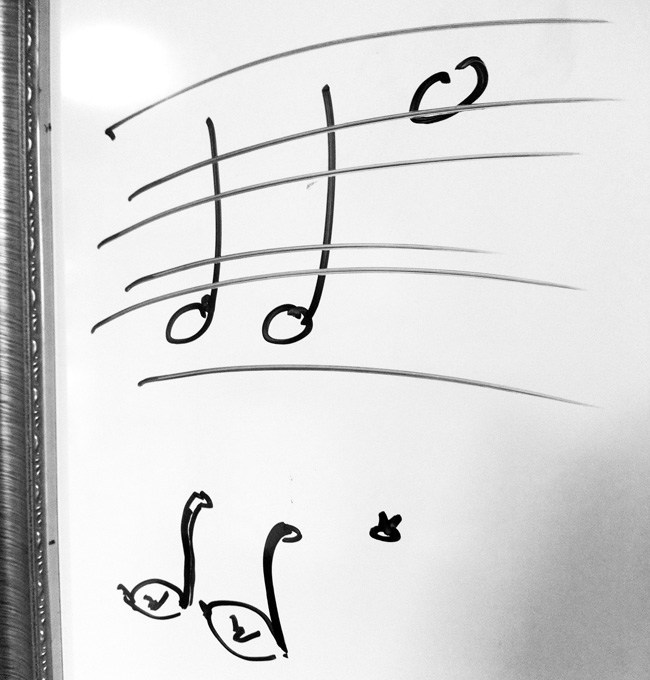
This morning, as the alarm was beginning, the song entered my mind as I was still somewhere in between sleep and reality. And in that synesthesia, for the first time, I saw the words as literal shapes: a swan, a swan, and a hummingbird. And you know what those shapes look like? Musical notes. Maybe even the first three notes of the vocal melody.
I jumped out of bed and drew this on the whiteboard in the hallway, my eyes still adjusting to the light.
Could this be it? An insight to what those words mean, finally, after 20 years of wondering? Could I be right? Only Michael Stipe would know for sure. (Confidential to MS: Email me. I’m “fraying” at the gmail dotcom.)
I take a lesson from this experience. Some mental puzzles have long timeframes. So long that, sometimes, when I’m feeling down, it can seem like nothing’s making any progress. But that’s not true. I’m working things out as fast as I can. Sometimes that’s just not very fast. Some things have to simmer. Some questions can’t be answered without a few more years under your belt. That’s just the way it works. So be patient. The goal isn’t to figure everything out right now. The goal is just to survive long enough to have a chance a finding an answer or two.
A pistol hot cup of rhyme,
The whiskey is water, the water is wine
In her prime, Spoo was a lap-warmer, fearless explorer, lover of boxes, occasional houseplant destroyer, hunter of moths, neighborhood cat brawler, and playmate to our dog, Chieka. I got her a couple years after I moved to San Francisco, and she’s been with me through every major life change – from apartment to house, girlfriends to wife, and more startups than I can count. She was always there.
Over the last year, she drew inward and became confused, sometimes not even recognizing Heather or me. She stopped going outside and her world got smaller and smaller. Vet visits and tests confirmed that there was no treatment to be had – she was just old. We lived with the early morning yowling and occasional litterbox miss. We tried different food, little kitty houses, and even cat Prosak. But when she pissed in the hallway twice in one day, and sat in it crying in sadness and confusion, we knew we couldn’t continue this way.
She was put to sleep today at 9am. She was purring in my arms at the end. As Heather and I held hands, crying and petting her, saying goodbye, she let out one final, tiny, rebellious fart.
She did not go quietly. I’m going to miss her like hell.