This is Derek Powazek Fray Magazineer
This is Powazek
Castro Flower ShopTiredHappy breakfastUpPupSmog Queen LoungeCold Drinks
<begging> Prove your love. Subscribe to Fray! </begging>

Rule 1 for Collaborative Media: Ask First

Here’s what happened, as far as I can tell.

Lane Hartwell is a fantastic photographer. She recently went full-time with her photography career.

A few weeks ago, an acapella group called the Richter Scales did a parody of Billy Joel’s song, “We Didn’t Start the Fire,” with new lyrics about the internet. They made a music video and put it on YouTube. The video was a slideshow of photos, all taken from the internet, to illustrate their song.
Lane Hartwell
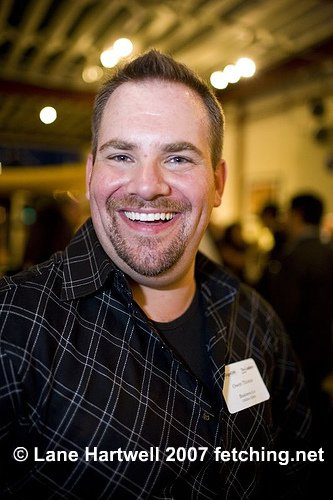
The photo of Owen Thomas, by Lane Hartwell, used in the Richter Scales video. (Use of the photo here, in a story about the photo, is the very definition of Fair Use.)

One of the photos used in the video was of Owen Thomas from Valleywag, shot by Lane Hartwell, and published in Wired News. Lane still owns the copyright to this image, and it was used without her permission.

I have no firsthand knowledge of what happened next, but I’ve been through it myself many times, so allow me to paraphrase: The photographer says, Hey, you don’t have my permission to use my work. And the person who grabbed the photo says, It’s the internet! Suck it!

What’s different about this case, however, is it appears that Lane filed a copyright complaint with YouTube. The DMCA says companies that host user-submitted content are not liable, so long as they act on copyright infringement claims. So YouTube did what they have to do to maintain compliance with the law: they took the video down.

Then Wired News posted about it and a bunch of blowhards blew it all out of proportion and all hell broke loose: bloggers became lawyers all of a sudden, with everyone having an opinion about fair use, parody, the value of photos online, and the content of Lane Hartwell’s character. Unfortunately, this story is not about any of those things.

Here’s what this story is about, and this point seems to have been thoroughly missed by everyone involved: Ethical practices in social media.

The Richter Scales had a funny song. (Cool!) They decided to make a video and put it on YouTube. (Smart!) Then they decided to take photos from online sources for their video. (Dumb.) They did not contact any of those photographers, get their permission, or give them credit in the final product. (Really dumb.) And when one of the photographers contacted them, they obviously did not treat her with the proper respect. (Really, really dumb.)

The Richter Scales guys are not evil, they were just lazy. Contacting all those photographers would have been really time-consuming. But it was the right thing to do, and they didn’t do it. This kerfuffle is their fault, not Lane’s.

Had they simply contacted all the photographers, told them about their project, asked nicely for their permission, and given them credit in the final product, 99% of them would have said yes. In fact, most of them probably would have been proud, linking to the result, and helping promote it. And the few that didn’t want to participate could have politely declined, without any drama.

Or they could have limited their photo selection to Creative Commons-licensed photos, listed by their creators as available for exactly this kind of project. (Of course, that would have required crediting the photos, too.)

But they didn’t do any of those things. They took creative works for which they did not have permission, and made a derivative work. That is a clear copyright violation, and their video is gone from YouTube as a result.

As more attention is focused on social media, and people become more aware of the value of all that media, this kind of thing is going to come up a lot. It’s time that we develop some ethical practices for the creation of collaborative media. Simply asking for permission to use someone else’s work is a good place to start.

27 Comments

Some folks probably don’t know the difference between copyright, creative commons licenses, and “hey, it’s on the internet, it must be free!”, but I suspect most don’t ask because they’re afraid they’ll be turned down. Easier to use the work and hope you don’t get caught than to ask and have your great idea blown to bits. Easier, but not right. It might be a great idea, but if you don’t have permission to create derivative works, it’s a non-starter.

Thanks for posting this.

Lori on 17 December 2007 @ 3pm

I’m with you on the lazy process. Being a photographer and having had things ripped from various sites I feel Lane’s pain.

But, what bothers me more is what you only allude to: that the internet turned into a lynch mob with some wanting to lynch Lane for being protective of her work and no doubt some wanting to lynch the lazy Richter Scales folks for stealing it.

This happens often and it scares me. One of the drawbacks of the ADHD world of short attention spans reading RSS slugs and Twitter fragments is that few think deeply about this stuff, they just react on limited knowledge. At least in the old analog days we had time to consider things, now it’s all bunched up in a way that makes consideration near impossible.

Richard on 17 December 2007 @ 3pm

Thanks for talking about this, Derek.

Lane Hartwell on 17 December 2007 @ 3pm

I’m amazed at the number of people who don’t create/share content who want to decide what is reasonable for me to ask for.

I’m _more_ amazed at fellow content creators who tell me what’s unreasonable for me to ask for and set limits on.

And it seems like there’s a lot of indigence about it, as if politely asking for respect, along the lines of, “Would you mind cleaning up after your dog poops in my yard,” is somehow equivalent to being an evil copyright/patent overlord. It’s a lot harder to play along if, suddenly, you’re the asshole for asking people to not shit in your yard.

It’s harder to build respect for a reasonable movement (CC/Social Media) if independent observers can’t see that reasonable requests of that movement are honored and even appreciated.

Thanks for bringing some light to the issue.

Nathan L. Walls on 17 December 2007 @ 3pm

Thanks for the awesome post, Derek. I’m glad you piped into this.

Just so you know…there were some people who DID talk about the ethics in that Techmeme list:

Evelyn Rodriguez: http://evelynrodriguez.typepad.com/crossroads_dispatches/2007/12/societal-ideals.html
Shelley Powers: http://burningbird.net/photography/den-of-thieves/
Me (although Techmeme seems to have dropped me from the list now? odd): http://www.horsepigcow.com/2007/12/16/tragedy-of-the-commons-lane-hartwell-vs-richter-scales/

I’m constantly amazed at how many times we miss the ‘heart’ in these debates. Personally, I could care less about the law. It is about respect for the content creators…ESPECIALLY if one is a content creator themselves. It’s a delicate ecosystem that requires mutual respect. As you well know, communities would not survive without it.

Tara Hunt on 17 December 2007 @ 5pm

Derek - great summary. I am a stickler for this stuff 0 copyright or CC or whatever. Sheesh - I go so far on my preso’s that if one bullet or the idea of the slide came from something I read on some one else’s blog or website, I put an “inspired by” note on the bottom - not so hard and goes a loooong way.

It’s about reciprocity and respect for other’s work as well–if nothing else - the practical knowledge that this stuff travels! Just good internet karma.

deb schultz on 17 December 2007 @ 5pm

well said, i wish those “blowhards” would read it. bravo

jeremy on 17 December 2007 @ 5pm

I’ve purposely not been following this that closely, though it is an issue that concerns me greatly.

I think you’ve done the issue justice and brought it to the point that most needs consideration and informed discussion. Thanks for putting the issues in such coherent light.

Chris Messina on 17 December 2007 @ 10pm

You are right in every observation. If it were one of my photos, I would have been extremely upset. In fact, I recently sent an invoice to a Seattle newspaper, after they grabbed one of my photos (clearly marked as being copyrighted), and used it on their own site. That was a traditional paper that should be well versed in these things, the point being that even these people seem to think that it’s free if it’s online. Not so. They ended up paying me for the image and did so with an apology and no complaints, probably because they knew the law was on my side.

Fair use, parody etc. is a grey area and it can be hard to tell when it’s okay to use a photo. But perhaps it would be prudent to err on the side of caution and at least ask first. I am sure, as you say, most photographers would be happy to contribute.

Rasmus on 17 December 2007 @ 11pm

hmm… guess i don’t feel that Lane’s DMCA takedown notice was an appropriate response to the “crime” (or rather rude non-crime, as the case may be).

i certainly understand & appreciate her frustration (& i kind of understand her response, tho i don’t agree), but i would have to say that expecting a large % of humanity to ever “get” the ethics here is unlikely… and probably just a setup for further & future frustration.

if we really want to come up with a solution, i think there needs to be a better way. whether that’s watermarking photos and/or figuring out a pattern-identification algorithm that gets built into the browser & allows for registration of images, i’m not really sure. but expecting a large % of humanity to either a) become legal experts, or b) start being polite is just not very likely.

there are 3 things i’m very positive won’t change:
1) a majority of people won’t stop appropriating images for their largely non-commercial uses
2) those same people won’t ever understand copyright, creative commons, or fair use… or likely even the “ethics” of asking first
3) people who expect things other than #1 & #2 will continue to be frustrated

my .02,

- dmc (but not ‘a’ ;)

dave mcclure on 18 December 2007 @ 12am

Derek: good post!

dave mcclure: I largely agree with your 3 points, but think that the Richter Scales should be held to a higher standard than the “majority … for largely non-commercial use”. The group sells a CD and presumably charges admission for (some of?) their concerts. They should take “all rights reserved” seriously. The DMCA was probably way too blunt of an instrument here, but that shouldn’t blind us to the fact that the first offense was made by the Richter Scales.

Scott Lawton (Blogcosm) on 18 December 2007 @ 9am

Derek, just like everyone else I agree with almost everything you said. I especially agree with your listing of how the process went down and your descriptors of good/dumb/really dumb.

I disagree with your statement about the “99%” bit though. I don’t know Lane from a hill of beans, so I won’t presume to speak for her, but I’ve asked for non-profit usage on a ton of copyrighted freelance images on the web and I’ve never had anyone agree to it without expecting to get paid. And to clarify, I’ve never wanted to use images for anything derogatory, inflammatory, dangerous or otherwise. I understand that idea; I’m not grousing about it. However, I don’t think most artists would simply agree because it was a cool idea and they’d just like the credit.

However, in line with what someone else said, these guys are in the same business of producing and selling media. They should know better. Even if they didn’t know better, handing out disrespect is never excusable. Kudos to Lane for standing up for her work.

Joel on 18 December 2007 @ 12pm

If a photographer were in front of you holding a stack of prints, you certainly would not just grab a few and walk away. Asking permission is polite and the correct way to gain usage rights but I’d never assume that the person would say yes without expecting to be paid in some fashion. the novelty of being credited at the end of a You Tube video doesn’t pay the mortgage.

JoeG on 18 December 2007 @ 12pm

Great post; I’ve enjoyed this continuing discussion. But as you say, bloggers have become lawyers, and I’m afraid you’re even falling into that trap yourself.

But they didn’t do any of those things. They took creative works for which they did not have permission, and made a derivative work. That is a clear copyright violation, and their video is gone from YouTube as a result.

The reason it is gone from YouTube is because Lane and her lawyer took action. It is heartening to know that simply taking action will get a result, but I disagree that there was a “clear copyright violation.” In fact, as Jason Schultz (LawGeek, and a friend of Lane’s) illuminates, there is likely no copyright infringement.

Such uses include but are not limited to parody, criticism, commentary, news reporting, educational use, etc.
http://lawgeek.typepad.com/lawgeek/2007/12/copyright-fair.html

As you both discuss in your posts, it is ethics that should circle ’round to the heart of this debate among us internet-types. The more we can do to educate people — whether it’s with clear watermarks or huge disclaimers — the more the idea should catch on. Though I do agree with some of the other commenters that most people are never going to understand and comply.

Ahh well. Thanks to you and to LawGeek for your posts!

Hillary Hartley on 18 December 2007 @ 12pm

As someone who had to procure media use permissions as part of a job, I can see why the Richter Scales just said “screw it” and didn’t even bother. It can be really difficult to get a response from people, but that does not forgive their use of Lane’s work. I’ve had to scrap the use of some images because we couldn’t get permission. You move on, find something you can get permission to use, but you don’t steal.

ElleBelle on 18 December 2007 @ 3pm

Derek, great post, simple and straightforward.
I would have to agree with dave mcclure in regards to educating the masses. Currently the way creative content is created remixed and shared is done illegally because its so darn easy so ppl dont bother with proper attribution.

Its one of the main reasons we are working on Aviary ( http://a.viary.com )We hope to make the process of creating and remixing content as easy as stealing content.

michael galpert on 18 December 2007 @ 4pm

while keeping track of everyones attributions forever ;-)

michael galpert on 18 December 2007 @ 4pm

Well written, and right on.

It’s a common problem in the artistic world about whether it’s easier to ask permission or ask forgiveness. The social reality of the internet makes the latter the most attractive option, or at least the default (in)action.

The problem is that it works. The example that comes to mind for me is with the band The Verve, and their song “Bittersweet Symphony,” for which they sampled an orchestral track from the Rolling Stones song “The Last Time.” The ensuing legal actions ensured that they haven’t made a penny for that song.

But they’ve enjoyed many of the benefits of having a hit song, probably opening other doors. (The Verve were well known musicians in the UK, but not as well known in the U.S., and at least for me, unknown until that song came out.)

It’s my opinion that many (unknown) musicians would risk sacrificing one song and its rights if it created notoriety for them down the road.

ben on 19 December 2007 @ 6am

Lots of smart comments here, so I hope a followup is ok.

I criticized the Richter Scales (above) and tried to find a middle ground in my earlier post. But Hartwell’s latest action (sending the band an invoice) hastens the demise of her profession.

The world is changing and business (which includes photographers who charge for their work) must adapt. I don’t doubt that Hartwell *believes* she’s been wronged, but a little perspective is in order. I’ll bet most people’s reaction is going to be something like: “if professional photographers are so greedy, who needs them?”

Scott Lawton (Blogcosm) on 19 December 2007 @ 11am

Hillary - Damn right I’ve become a lawyer. After putting my creative works on the internet since 1991, I’ve had to. If you think that taking a photo and putting it in a video isn’t a derivative work, you could use some law classes, too.

Derek Powazek on 19 December 2007 @ 11am

Everyone seems to be glossing over the fact that the video was a parody of “Web 2.0″, that the photo was of a person involved in Web 2.0, taken by a photographer who covers things connected to Web 2.0.

Should the group have given attributions? Sure. Even if you use it for a college class report there are rules about attribution. But ask for permission? Not in a parody, which is fair use.

Copyright is supposed to assist creativity and innovation, not stifle it.

If there is anything that points to a need for reform of IP laws, this case is it.

The DMCA provides that the owner of IP can request a take-down of something posted (not just videos on YouTube). But the Richter Scales could have also, under the DMCA, cited their work as parody and requested reinstatement. At that point, Lane would have had to go to court to get it taken down. As many have commented, some of whom are in the legal profession, Lane would likely have lost because of the parody.

Woadan

Woadan on 20 December 2007 @ 5pm

Woadan — When I was the editor of JPG, I published a photo essay of Lane’s that was about the East Bay Rats, a motorcycle club. Is that about Web 2.0, too? Lane’s work has nothing to do with “Web 2.0,” and stealing her photos is not covered by calling it parody.

Derek Powazek on 20 December 2007 @ 10pm

Thanks for sharing your insight into this issue. I’m a bit concerned because for a moment I thought what Dave McClure said could have been written five years ago about music on the internet.

Music, photos, blog quotes, illustrations… I appreciate art and care about proper attribution, but how has the internet changed distribution? How will the business of creating artwork adapt?

Leah Culver on 21 December 2007 @ 2am

We are having issues on this - and this was the MOST reasonable article out there that I have found so far.

If one writes, creates or makes something - no one has the right to take it - we learned that in GRADE SCHOOL. It is called “coping and cheating”.

Some will even take TM information - and all one wants out there is acknowledgment and credit for their work.

E Doyle-Propst on 24 December 2007 @ 9am

Fair use can be tricky, but I think many people twist it farther out of shape so they can excuse their own behavior. A parody is something addressing an original work. Commentary, news reporting, and educational use can all come into play when the copyrighted work is the item of study or discussion. But to use a work to promote a song seems a pretty commercial endeavor, and when it’s commercial in that fashion, it falls out of fair use. What “hastens the demise” of professional photography is not that a photographer insists not just on payment, but on control of use and presentation of her work. The real problem is that people assume they shoudl be able to take whatever they want because it is easy to copy it. As that continues, fewer and fewer people will be able to afford being in any creative endeavor, because they will have to make a living. The upshot is that be demanding everything for free, the people doing so are setting the conditions to ensure that eventually there will significant limits on new work, at least at a professional level.

Erik Sherman on 28 December 2007 @ 5pm

Coming in late on this, but just wanted to give my two cents worth.

I’ve been on the wrong end of plaguarism twice, and it’s not nice.

No one - repeat, no one - has the right to use your work without permission. As creatives, we have every right to expect our ‘products’ to be paid for in cold hard cash.

Those who have day jobs expect bossess to pay for their services. Those of us who use our creativity as a way to earn our living also expect to be paid for our services.

Bottom line: it’s our personal creation and we have every right to be paid for it. Whether it’s on or off the internet makes no difference whatsoever. And whether or not it’s for a non-profit makes no difference either.

Would you expect your neighbor to give you his car for free? I doubt it. So why would you expect a writer or photographer to supply their product/goods/services for free?

Unfortunately the internet has made it much easier for people to steal our work, and in record time.

Lane, good on you for standing your ground. I’m right behind you!

Cheryl

Cheryl Wright on 1 January 2008 @ 4pm

I came here via blurbomat.
THANK YOU for your post!
May I use it as an example in my middle school classroom?
School starts tomorrow :O

Ellen on 1 January 2008 @ 7pm

Comments for this post are now closed.